
Polymer concrete
technology – the future of
prefabrication
Innovative composite in which cement is replaced by resin. the products are stronger, more durable and more resistant to external conditions than traditional concrete.
production
process
Aggregate selection
Adding resin
Forming the element
Hardening
Ready prefabricated element
Polymer concrete technology – the future of prefabrication
Innovative composite in which cement is replaced by resin. the products are stronger, more durable and more resistant to external conditions than traditional concrete.
POLYMER CONCRETE is a modern composite that uses synthetic resins instead of cement.. Thanks to this, our material combines the advantages of high-strength concrete with chemical resistance, fast hardening and exceptional smoothness.. INPOLCON uses these features to produce products – from infrastructure elements to architectural solutions – that are not only durable, but also aesthetic and light. .
POLYMER CONCRETE
|
RESIN CONCRETE
|
POLYMER CONCRETE
POLIMEROBETON
BETON ŻYWICZNY
BETON POLIMEROWY
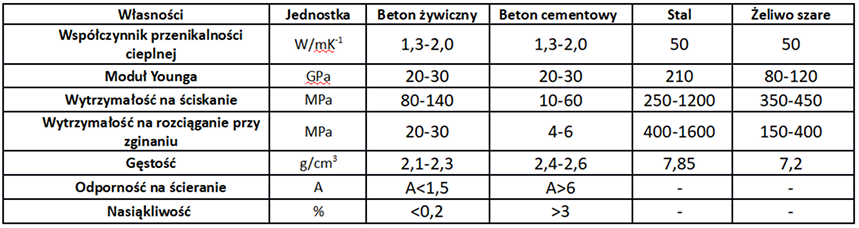
Comparison of the properties of POLYMER CONCRETE, cement concrete, steel and cast iron:
key features of the material
Exceptional durability
and durability
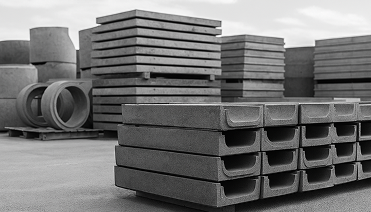
The finished polymer concrete element is characterized by strength comparable to high-strength concrete (HPC)
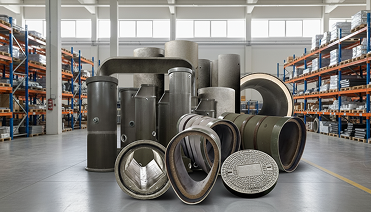
Resistance to chemical corrosion, aggressive environments and negligible water absorption make this material ideal for use, e.g. in sewage, chemistry, energy
Chemical resistance
and low water absorption
Fast hardening and
excellent surface smoothness
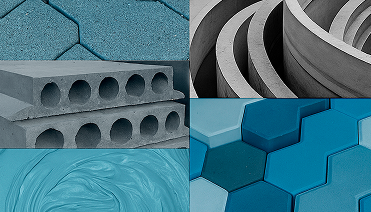
The resin base makes polymer concrete harden faster than traditional concrete, and the surface is very even and aesthetic.
key features of the material
Exceptional durability
and durability
The finished polymer concrete element is characterized by strength comparable to high-strength concrete (HPC)
Chemical resistance
and low water absorption
Resistance to chemical corrosion, aggressive environments and negligible water absorption make this material ideal for use, e.g. in sewage, chemistry, energy
Fast hardening and
excellent surface smoothness
The resin base makes polymer concrete harden faster than traditional concrete, and the surface is very even and aesthetic.
More about polymer concrete
Resin concrete due to its physical properties meets the demand for high-quality materials. It is a material with features that distinguish it from other building materials, including .. due to very high load resistance, abrasion resistance, low water absorption and high chemical resistance.
It is preferred in situations where strength considerations and the working environment play a decisive role in the selection of the appropriate material.
Due to its considerable durability, products made of this material will be preferred for structures located in the area of communication routes as well as in cases of installation at significant depths. Compressive strength puts prefabricated polymer concrete elements higher than concrete ones – at the level of high-performance – ultra-high-strength concrete (HPC).
When choosing the material of building elements, the weight of the element also plays an important role, which in the case of polymer concrete is significantly lower than similar elements made of concrete or . reinforced concrete.
It is a dielectric material. It has electrical resistance at the level of hard rubber.
Comparing traditional concrete with cement as a binder, it is a composite in which the cement binder has been replaced with resinand the fillers are usually various fractions of quartz aggregate.
Resin-based concretes are not used to produce . water.
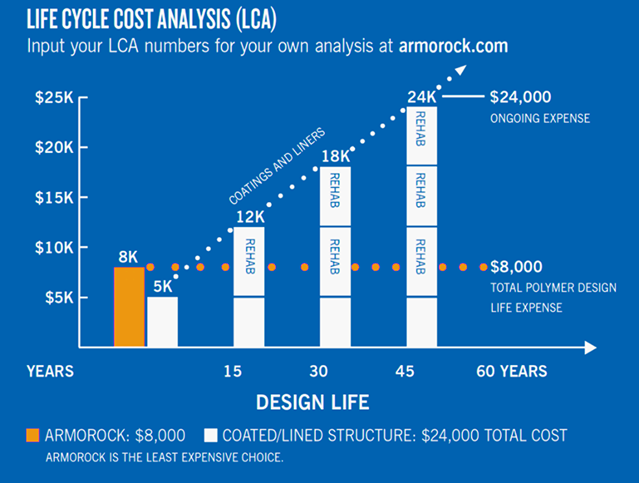
Comparison of durability and cost of sanitary elements made of polymer concrete and cement concrete:
Source.: https://armorock.com/ https://pipegreen.com/
Corrosion of concrete: https://seidel-przywecki.eu/2020/11/18/korozja-betonu/
Why does polymer concrete win in practice?
Very high chemical resistance supports the use of polymer concrete in places particularly exposed to increased
and long-term exposure to aggressive chemicals. These are places that should be characterized by high chemical resistance of the materials used
in sewage systems and industrial installations m.in.: tanks, pipes, wells, renovation cladding of degraded elements.
Due to compressive strength and low surface roughness . external (the coefficient of friction with the ground is much lower than in the case of concrete), pipes made of polymer concrete are an excellent material for making channels
and culverts using the microtunnelling method. In turn, their use in „classic” gravity sewage networks is supported by hydraulic considerations: due to the low roughness coefficient, polymer concrete pipes . are eagerly used to build channels with slopes smaller than the norm. .The requirement for currently used solutions is reliability. Due to its long service life, polymer concrete products meet this requirement.
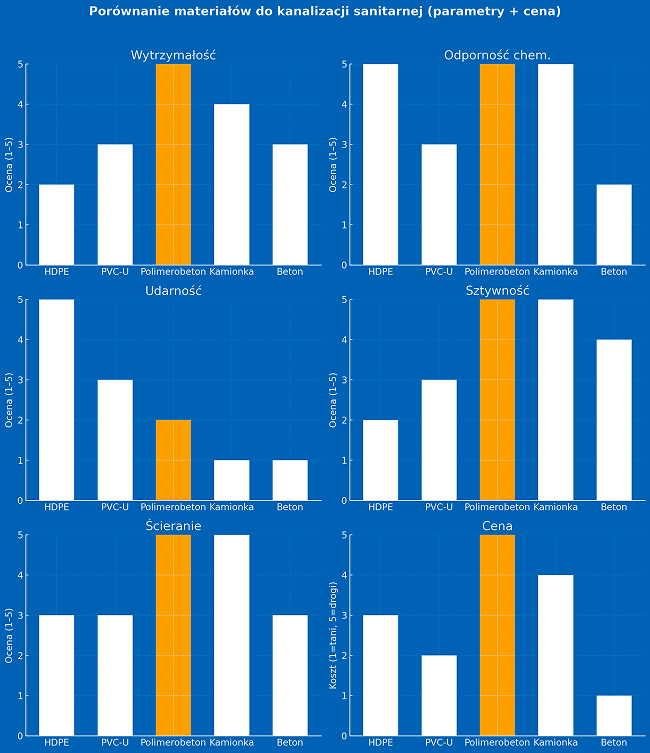
Polymer concrete stands out from traditional materials used in sanitary sewage systems – such as concrete, stoneware or plastics – thanks to its unique combination of strength, chemical resistance and longevity.
In the lists of technical parameters, it achieves the highest ratings in terms of abrasion, stiffness . and chemical resistance, while surpassing traditional concrete. Importantly, the life cycle cost analysis shows that although the initial price of polymer concrete is higher, the lack of the need for frequent repairs and replacement makes it a much more economical solution in the perspective of several dozen years.
Resins used
in polymer concretes:
- polyester
- vinyl ester
- epoxy
- polyurethane
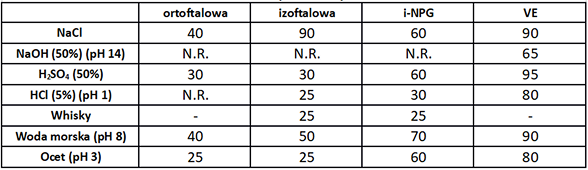
Table of the maximum operating temperature of the resin in a chemical environment
– comparison of chemical resistance of resins
We have machinery for the production of polymer concrete products (Polyester resin concrete – PRC, Polymer concrete – PC) from the renowned company ADM-ISOBLOCK GmbH, operated by qualified technicians with many years of experience
OUR MACHINE PARK
We have machinery for the production of polymer concrete products (Polyester resin concrete – PRC, Polymer concrete – PC) from the renowned company ADM-ISOBLOCK GmbH, operated by qualified technicians with many years of experience